

- access_time24 November 2025
- account_circleJuan Dangelo
- Ceramic Coating
As a yacht owner, you know the battle against the marine environment is never-ending. Between the saltwater, the harsh UV rays, and the corrosive nature of sea air, keeping your vessel’s gelcoat or paint in pristine condition is a full-time job.
In recent years, a solution has migrated from the luxury automotive world to the marina: Ceramic Coating. But is it just hype, or is it the hull protection miracle you’ve been waiting for?
Below, we break down exactly what this technology is and analyze the pros and cons to help you decide if it is the right investment for your vessel.
What is Ceramic Coating for Yachts?
Before weighing the benefits, it is essential to understand what you are actually putting on your boat.
Ceramic coating is a liquid polymer solution—typically composed of Silicon Dioxide (SiO2)—that is applied by hand to the exterior of a vessel.
Unlike traditional marine wax, which sits on top of the surface and washes away over time, ceramic coating chemically bonds with the yacht’s factory gelcoat or paint at a nanoscopic level. Once cured, it creates a semi-permanent, rigid, and transparent shell. Think of it not as a wax, but as a sacrificial layer of glass-like skin that shields your boat’s actual finish from the elements.
The Pros and Cons: A Quick Snapshot
If you are short on time, here is the breakdown of the major advantages and disadvantages of marine ceramic coatings.
The Pros (Why Owners Love It)
|
Benefit |
Description |
|
Superior UV Protection |
Blocks UV rays that cause gelcoat oxidation, fading, and yellowing. |
|
Hydrophobic Properties |
Repels water, preventing water spots and creating a "self-cleaning" effect. |
|
Extreme Gloss & Shine |
Enhances the depth and clarity of the paint/gelcoat for a "wet look" finish. |
|
Reduced Maintenance |
Makes washdowns significantly faster and eliminates the need for waxing. |
|
Chemical Resistance |
Protects against bird droppings, acid rain, fuel spills, and exhaust soot. |
The Cons (The Trade-offs)
|
Drawback |
Description |
|
High Initial Cost |
Significantly more expensive upfront than wax due to labor and product cost. |
|
Demanding Prep Work |
The surface must be perfectly corrected (polished/sanded) before application. |
|
Not Damage Proof |
It is scratch-resistant, not scratch-proof. It won't stop heavy impacts or deep gouges. |
|
Difficult Removal |
Because it bonds to the surface, it must be mechanically abraded (polished) off to be removed. |
|
Application Sensitivity |
Requires specific temperature and humidity conditions to apply correctly. |
Benefits of ceramic coatings for yacht maintenance
1. The End of Frequent Waxing
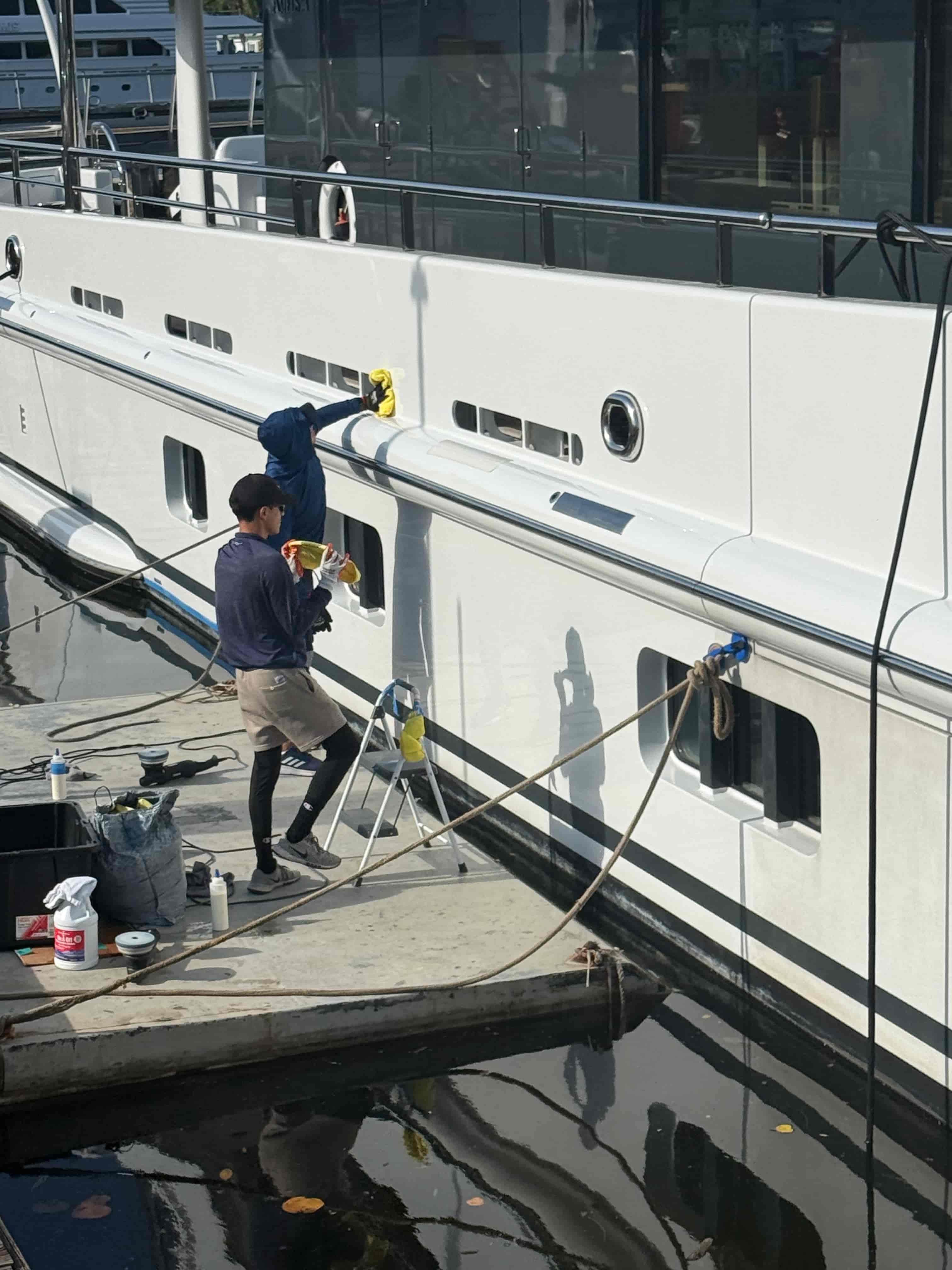
The most attractive selling point for captains and owners is longevity. While marine wax lasts 2 to 4 months in harsh saltwater environments, a professional marine ceramic coating can last 18 to 36 months (or longer with multi-layer packages). This frees you from the quarterly cycle of buffing and waxing.
2. The Hydrophobic "Self-Cleaning" Effect
Ceramic coatings have low surface tension, meaning water beads up and rolls off rather than sitting flat on the surface. When you spray down the boat after a trip, the water picks up dirt, salt, and grime and rolls it right off. This can cut your wash-down time by up to 50%.
3. Protection Against Oxidation
Gelcoat is porous. When UV rays hit it, the surface oxidizes, turning chalky and dull. Ceramic coating fills those microscopic pores and seals the surface with a UV inhibitor, effectively locking out the sun and keeping the white gelcoat bright and the colored hulls vibrant.
The Disadvantages
1. It Reveals Imperfections
Ceramic coating is transparent and acts like a magnifying glass. If you apply it over a hull that has swirl marks, scratches, or oxidation, the coating will lock those imperfections in and arguably make them more visible. This is why Paint Correction (polishing and compounding) is mandatory before application, driving up the labor cost.
2. You Still Have to Maintain It
"Maintenance-free" is a myth. While you don't need to wax, you do need to wash the boat regularly with specific pH-neutral soaps. Using harsh deck brushes or strong acids can strip the coating prematurely.
3. The Cost Factor
Because the preparation is labor-intensive, the price tag is high. You are paying for the hours of skilled labor required to restore the hull to perfection before the bottle of coating is even opened. However, when you calculate the cost of waxing 3-4 times a year versus coating once every 3 years, the long-term math often balances out.
Is yacht ceramic coating worth it?
-
YES, if: You plan to keep the boat for several years, you want the highest possible gloss, and you want to reduce the effort required for washdowns.
-
NO, if: Your gelcoat is already heavily damaged and you aren't willing to pay for restoration, or if you prefer the traditional ritual of waxing your boat frequently.
Ultimately, ceramic coating is the modern standard for marine protection. It is an investment in your vessel’s aesthetic appeal and resale value.
Still undecided on whether to make the
switch? We know that replacing your trusty tin of Carnauba wax with
a modern coating is a significant investment. To help you look at,
the maintenance, and the longevity of both options side-by-side,
check out our full comparison guide: Wax vs. Ceramic Coating: Which is Right
for Your Yacht?
Recent Posts
- Created at : 16 December 2025
- Created at : 16 December 2025
- Created at : 29 November 2025